
Over Under in Sports Betting: Totals Line Construction and Pace Analysis
For a beginner overview of events, selections, odds and stakes, read what sports betting means before moving into totals markets.
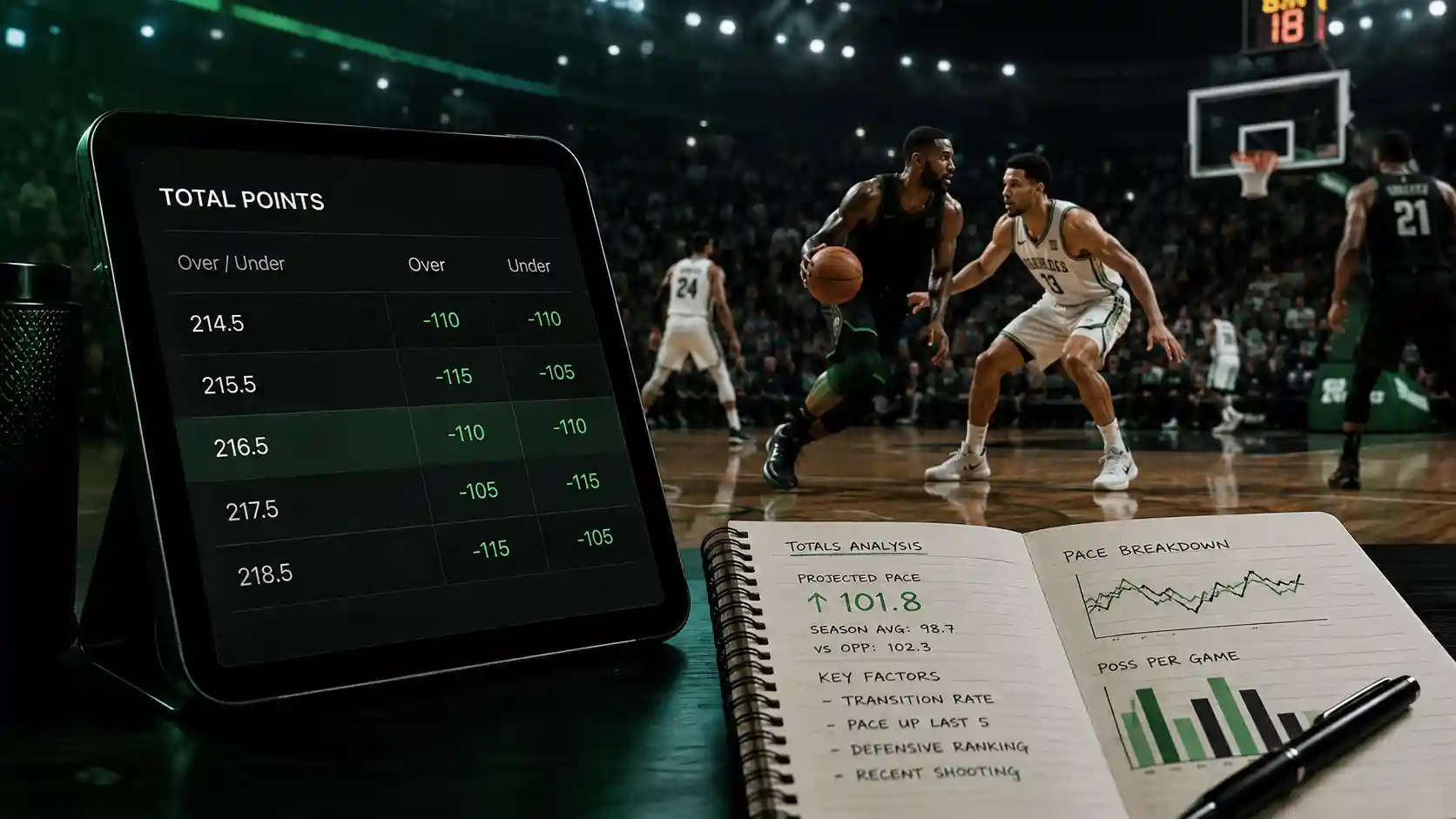
Totals market guide readers can use this lesson to separate the scoring line from the price attached to it. This over under in sports betting guide explains pace, overtime, line movement, pushes, and settlement rules.
- Combined Score Metric: The benchmark represents the sum of points, goals, or runs scored by both competing teams.
- Over Wager: Wins if the aggregate final score exceeds the posted total line (e.g., 219 points in a 218.5 line).
- Under Wager: Wins if the aggregate final score finishes below the benchmark (e.g., 218 points or fewer).
- Overtime Scoring Inclusion: Points scored in basketball overtime periods are included in full-game totals settlement.
- Statistical Pace Analysis: Possessions per 48 minutes, shooting percentages, and referee tendencies are prime analytical inputs.
How Totals Lines are Structured in Basketball (NBA & PBA)
In professional basketball, sportsbooks post totals lines reflecting projected possession counts and offensive ratings. Consider an NBA clash between the Indiana Pacers and Sacramento Kings:
- Total Line: 236.5 Points
- Over 236.5: 1.90
- Under 236.5: 1.90
If the final score finishes Indiana 122 - Sacramento 118, the combined total is 240 points. Because 240 is greater than 236.5, all "Over" tickets win, returning ₱1,000 × 1.90 = ₱1,900.00. Conversely, if the game concludes 114-110 (224 points), "Under" tickets win.
| Final Score Result | Combined Total | Over 218.5 (1.90) | Under 218.5 (1.90) | Settlement Note |
|---|---|---|---|---|
| Team A 112 - Team B 108 | 220 Points | WIN | LOSS | 220 > 218.5 |
| Team A 105 - Team B 102 | 207 Points | LOSS | WIN | 207 < 218.5 |
| Team A 98 - Team B 98 (Reg) → 110-108 (OT) | 218 Points | LOSS | WIN | 218 < 218.5 (Half-point hook avoids push) |
Overtime Rules in Totals Betting
A vital structural rule for Philippine sports bettors to understand is that overtime scoring counts toward full-game totals. If an NBA game concludes regulation tied at 100-100 (200 points) against a total line of 215.5, an overtime period that generates 20 additional points (111-109, totaling 220) will push the final combined score Over the benchmark.
Key Analytical Factors for Totals Handicapping
Successfully evaluating totals markets requires analyzing pace and efficiency metrics rather than simple historical averages:
- Pace of Play (Possessions per 48 Mins): Fast-paced teams that shoot early in the shot clock create higher shot volumes and greater point accumulation.
- Defensive Rebound Rate: Teams that secure defensive rebounds prevent second-chance scoring opportunities, depressing total point production.
- Back-to-Back Rest Fatigue: Teams playing on consecutive nights often experience shooting leg fatigue, leading to lower 3-point conversion rates in the second half.
Derivative Totals: Team Totals and Quarter Lines
Beyond full-game lines, sportsbooks offer Team Totals (wagering solely on one squad's point output) and First-Half / Quarter Totals, allowing targeted analysis of early offensive momentum.
Sources and Methodology
How this article was prepared
- Market examples are illustrative and explain selection, line, period, and settlement concepts.
- Operator rules vary, so the current market and settlement terms on the exact domain should be checked before use.
See our Editorial Policy for sourcing, corrections, and commercial-independence standards.
Review the Current Market Before Selecting
Match the event, market, selection, line, period, and settlement rule described in this guide with the current platform display.
Frequently Asked Questions
An over/under bet is a wager on whether the combined score of both teams will be higher or lower than a specified number set by the sportsbook.
Half points (the hook) ensure a decisive outcome, preventing push ties where stakes must be refunded.
Yes, standard basketball totals markets include points scored during overtime periods unless specified as regular-time only.